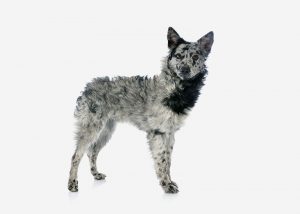
The Mudi is a rare herding dog breed from Hungary. It is closely related to the Puli and Pumi, from which it was separated in the 1930s. Today, the Mudi is bred for work, companionship, and conformation show. They continue to be used in herding, as well as participating in a variety of dog sports.
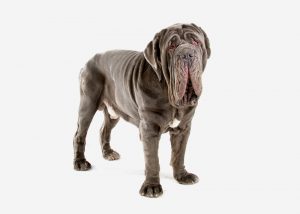
The Neapolitan Mastiff or Italian Mastiff, is a large, ancient breed of dog. This massive breed is often used as a guard dog and defender of family and property due to their protective instincts and their fearsome appearance.
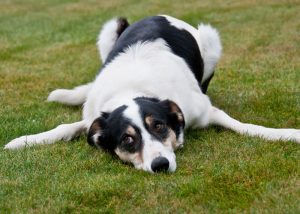
The New Zealand heading dog or New Zealand eye dog is a farm herding dog that uses its eyes and quick movements to control sheep. It was predominantly bred from the Border Collie, and therefore generally black and white, sometimes tan in colour.
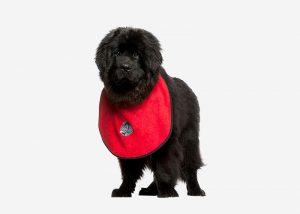
The Newfoundland is a large working dog. Newfoundlands can be black, brown, white and black (called Landseer) or gray. However, in Canada, the country of their origin, the only correct colours are black (including black with white markings) and white and black (Landseer). They were originally bred and used as a working dog for fishermen in the Dominion of Newfoundland (which is now part of Canada). They are known for their giant size, intelligence, tremendous strength, calm dispositions, and loyalty. Newfoundland dogs excel at water rescue/lifesaving because of their muscular build, thick double coat, webbed feet, and innate swimming abilities.
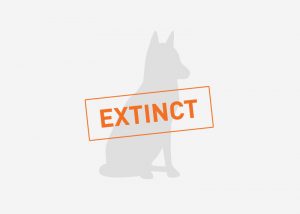
The Norfolk Spaniel or Shropshire Spaniel is a breed of dog extinct since the early 20th century. It was originally thought to have originated from the work of one of the Duke of Norfolk, but this theory was disproven after being in doubt during the later part of the 19th century. The term was used to designate springer type spaniels that were neither Sussex Spaniel nor Clumber Spaniels, and attempts were made to use it to specify a breed that would later become known as the English Springer Spaniel.With a liver-and-white or black-and-white coat, the Norfolk Spaniel was described as being a large cocker spaniel. The Spaniel Club set out a breed standard (dogs) for Norfolk Spaniels, but specimens of the breed varied greatly across England. Members of the breed were difficult to train, but formed a strong attachment with their owners and were useful for hunting both on land and in water. The breed ceased to exist after 1903, when it was rolled into the new English Springer Spaniel breed created by The Kennel Club to contain all spaniels of this type.
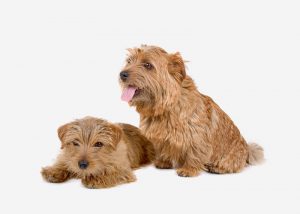
The Norfolk Terrier is a British breed of dog. Prior to gaining recognition as an independent breed in 1960, it was a variety of the Norwich Terrier, distinguished from the “prick eared” Norwich by its “drop ears” (or folded ears). Together, the Norfolk and Norwich Terriers are the smallest of the working terriers.
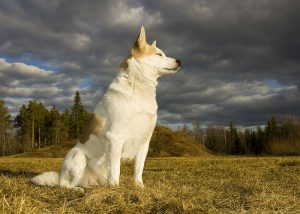
The Norrbottenspets is a dog breed of the spitz type. It is an ancient breed whose original purpose was a farm and hunting dog but has recently became more popular as a companion dog. The Norrbottenspets is used to hunt wood grouse, black grouse, capercaillie and hazel grouse, but also fox, marten and raccoon. Some individuals are also effective with mammals as large as moose and grizzly bear. Norrbottenspets was formerly used in hunting squirrels, when squirrel fur was valuable in the beginning of 20th century and earlier.
The North Country Beagle, Northern Hound or Northern Beagle was a breed of dog that existed in Britain probably until early in the 19th century. The exact date of its extinction is not known; it is likely that it was gradually interbred with other breeds, particularly the modern Beagle, until the genuine North Country Beagle bloodline ceased to exist.The origins of the North Country Beagle are equally unclear. Most writers suggest that it was developed from the Talbot, whose origins are also uncertain, but which some have claimed originated in Normandy. The Talbot was a predominantly white, slow, deep-throated, scent hound. At some point the Talbots were crossed with Greyhounds to give them an extra turn of speed, but they remained comparatively slow dogs that relied more on their nose than speed in the chase. The North Country Beagle was a large, bony hound with a square head, and long trailing ears. Chiefly bred in Yorkshire, it was common in the north of England, but below the River Trent the similar Southern Hound was more abundant. The North Country Beagle was a faster dog; in The British Encyclopedia of 1809, William Nicholson says that the North Country Beagle was kept by the “dashing class of sportsman” because it could “run down a brace [of hare] before dinner”, but although a good scent hound, was probably lacking in this ability when compared to the delicate nose of the Southern Hound. The writer and poet Gervase Markham, who wrote a number of books on animal husbandry in the early 17th century described the North Country Beagle as having:In his The Dog, in Health and Disease in 1859, “Stonehenge” (the pen name of John Henry Walsh, later editor of The Field (magazine)) says the two breeds could be differentiated by the large dewlap possessed by the Southern Hound. The Southern Hound seems to have also had a deeper more melodious voice; Markham says the North Country Beagle had “only a little shrill sweetness” and lacked depth of tone. How far the Talbot, Northern Hound and Southern Hound were intermixed by the 19th century is impossible to ascertain: while acknowledging that they had once existed as separate breeds, Stonehenge had never seen pure-bred varieties and classified the three breeds together.Both the North Country Beagle and Southern Hound seem to have fallen out of favour during the 18th century as the fashion for less time consuming hunts led to the development of the faster Foxhound. The North Country Beagle may have formed part of the packs kept by southern farmers for rabbit-hunting that would eventually became the nucleus for the modern Beagle breed. Stonehenge says that packs of hounds that resembled the description of the North Country Beagle still existed in Wales, Devon, Yorkshire and Sussex during the 19th century, but he was doubtful as to how far any of these packs truly represented any of the three early hound breeds.Aside from the Beagle other modern hound breeds are believed to have North Country Beagle blood: Harrier and Foxhounds among others. Coonhounds and Bloodhounds are likely to have had more influence from the Southern Hound and Talbot lines, as they are excellent trackers but not as swift as other hound breeds.
The Northern Inuit Dog is an unrecognized crossbred dog that originated in the late 1980s, in an attempt to create a domestic dog breed more closely resembling the wolf. It is currently only recognized by its own independent breed club, but by no other major kennel clubs. The dog originates from crosses among German Shepherd Dogs, Siberian Husky, and a variety of Inuit breeds. Although the original stock is Canadian in origin, the breed was developed in the UK.
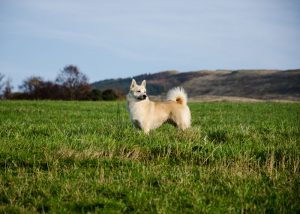
The Norwegian Buhund is a breed of dog of the spitz type. It is closely related to the Icelandic Sheepdog and the Jämthund. The Buhund is used as an all purpose farm and herding dog, as well as watch dog.
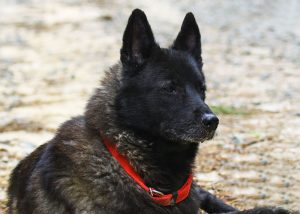
The Norwegian Elkhound is one of the ancient Northern Spitz-type breed of dog and is the National Dog of Norway. The Elkhound has served as a hunter, guardian, herder, and defender. It is known for its courage in tracking and hunting moose (or elk) and other large game, such as bear or wolf. The Norwegian Elkhound was first presented at a Conformation show in Norway in 1877.The American Kennel Club breed name “Norwegian Elkhound” is a direct translation from its original Norwegian language name Norsk Elghund, meaning “Norwegian moose dog.” The breed’s object in the hunt is to independently track down and hold the moose at bay—jumping in and out toward the moose, distracting its attention, while signaling to the hunters by barking very loudly—until the hunter who follows the sound can arrive to shoot it. The dog will only bark while the moose is stationary, but it can also slowly drive the moose towards shooters lying in wait. The Norwegian Elkhound is also used on a leash. In this mode of hunting, the dog leads the hunter in the direction of the moose while keeping quiet.
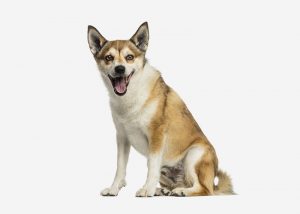
The Norwegian Lundehund (Norsk Lundehund) is a small dog breed of the Spitz type that originates from Norway. Its name is a compound noun composed of the elements Lunde, meaning puffin (Norwegian lunde “puffin” or lundefugl “puffin bird”), and hund, meaning dog. The breed was originally developed for the hunting of puffins and their eggs.