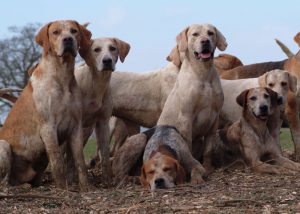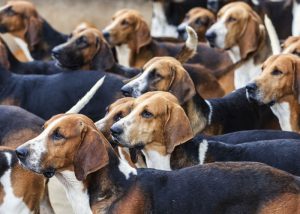
The English Coonhound, also referred to as the American English Coonhound (by the American Kennel Club only) or the Redtick Coonhound, is a dog breed of dog. It is a type of coonhound that is typically bred in the Southern United States. It has origins from hunting hounds brought to America by settlers during the 17th and 18th centuries, resulting in the dogs known as the “Virginia Hounds”. The breeds first recognition came from the United Kennel Club in 1905 as the English Fox and Coonhound. Further recognition has been granted in recent years by the American Kennel Club, first in the Foundation Stock Service and in 2011 as a fully recognized member of the hound group.The breed is of medium height and proportionate weight, and their Coat come predominantly in three types, redtick, bluetick and a tricolor tick pattern. They have a high prey drive and are used in various roles in hunting, including treeing. Health issues that the breed suffers from include overheating whilst out on summer hunting expeditions.HistoryThe breed traces its ancestry from Foxhounds brought to the United States by European settlers during the 17th and 18th centuries. The breed developed from the “Virginia Hounds”, which were developed over time from dogs imported to the United States by Robert Brooke, Thomas Walker (explorer) and first President of the United States, George Washington. The dogs had to adapt to more rigorous terrain, with the breed being specifically bred over time to suit these new conditions. It was recognized by the United Kennel Club (UKC) in 1905 as the English Fox and Coonhound. It was moved up to the Miscellaneous Class on 1 January 2010. Following the recognition of the breed by the AKC in the hound group on 30 June 2011 as the 171st breed,HealthEnglish Coonhounds can be prone to overheating while on coon hunts during the summer months in the Southern United States.
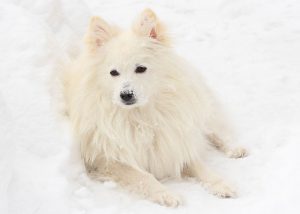
The American Eskimo Dog is a breed of companion dog originating in Germany. The American Eskimo is a member of the Spitz family. Despite its name and appearance, the American Eskimo dog is not from Alaska; the dog’s heritage is traced back to Northern Europe. The breed’s progenitors were German Spitz, but due to anti-German prejudice during the First World War, it was renamed “American Eskimo Dog”. Although modern American Eskimos have been exported as German Spitz Gross (or Mittel, depending on the dog’s height), the breed standards are actually significantly different. In addition to serving as a watchdog and companion, the American Eskimo dog also achieved a high degree of popularity in the 1930s and 1940s United States as a circus performer.There are three size varieties of the American Eskimo breed, the toy, miniature and the standard. They share a common resemblance with Japanese Spitz and Samoyed.Miniature American Eskimos, with their high intelligence and inquisitive nature, will love to “investigate”. If they find something very interesting they will often want their owner or handler to investigate as well, and will at times, not let the “matter” go until the person complies. You will often find this behavior when it comes to children; for instance, if a baby or child is crying, the American Eskimo will want you to see what the problem is and will not stop worrying until you do. The American Eskimo being so “tuned in” is one of the characteristics that makes them a desirable breed around children.HistoryThe American Eskimo Dog was originally bred to guard people and property and, therefore, is territorial by nature and a valiant watchdog. They are not considered an aggressive breed. But, due to the breed’s watchdog history, American Eskimos are generally quite vocal, barking at any stranger who comes in proximity to their owners’ territory.In Northern Europe, smaller Spitz were eventually developed into the various German Spitz breeds. European immigrants brought their Spitz pets with them to the United States, especially New York, in the early 1900s, “all of them descended from the larger German Spitz, the Keeshond, the white Pomeranian, and the Italian Spitz, the Volpino Italiano.”Although white was not always a recognized color in the various German Spitz breeds, it was generally the preferred color in the US. In a display of patriotism in the era around World War I, dog owners began referring to their pets as American Spitz rather than German Spitz.After World War I, the small Spitz dogs came to the attention of the American public when the dogs became popular entertainers in the American circus. In 1917, the Cooper Brothers’ Railroad Circus featured the dogs. A dog named Stout’s Pal Pierre was famous for walking a tightrope with the Barnum and Bailey Circus in the 1930s, and also contributing to their popularity, they sold puppies after the show. Due to the popularity of the circus dogs, many of today’s American Eskimo Dogs can trace their lineage back to these circus dogs. At that time there was no official breed club and no breed standard, and dogs were accepted for registration as single dogs, based on appearance. In 1970 the National American Eskimo Dog Association (NAEDA) was founded, and single dog registrations ceased. In 1985 the American Eskimo Dog Club of America (AEDCA) was formed by fanciers who wished to register the breed with the American Kennel Club (AKC). Following the AKC’s requirements for breed recognition, the AEDCA collected the pedigree information from 1,750 dogs that now form the basis of the AKC recognized breed, which is called the American Eskimo Dog. The breed was recognized by the American Kennel Club in 1995. The stud book was opened from 2000 to 2003 in an attempt to register more of the original UKC registered lines, and today many American Eskimo Dogs are dual-registered with both American kennel clubs. but is not recognized elsewhere in the worldThe American Eskimo Dog is not entirely an internationally recognized breed, and since neither of the American kennel clubs are affiliated with the Fédération Cynologique Internationale, fanciers wishing to participate in certain international dog shows will register their American Eskimo Dogs as the very similar German Spitz. This is done only by individuals wishing to participate in dog sports in international shows, and does not mean that the American Eskimo Dog and the German Spitz are the same. Although the American Eskimo is known as the German Spitz in several countries outside of the United States, the two breeds have actually developed somewhat differently since the American Eskimo was relocated to North America, over a century ago. It is not uncommon for German Spitz breeders to incorporate imported American Eskimo bloodlines into their breeding program to broaden the gene pool, and vice versa.HealthThe American Eskimo is a hardy breed with an average life span of 16 years. This breed tends to become overweight easily, so proper diet and exercise is needed to maintain an overall well being. Health testing should be performed by all responsible breeders and anyone purchasing a puppy should be aware of the genetic problems which have been found in some individuals of the breed, such as PRA (Progressive Retinal Atrophy), luxating patella, and Hip dysplasia (canine)). None of these problems are common and the breed is generally very healthy. In addition to the rarer problems mentioned, the breed can have a tendency towards allergies and most commonly, tear-staining. This breed also is known in some cases to have dental issues.
The American Foxhound is a dog breed that is a cousin of the English Foxhound. They are scent hounds, bred to hunt foxes by scent.
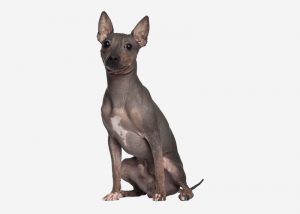
The American Hairless Terrier is a breed of dog that was formerly considered a variant of Rat Terrier. As of January 1, 2004, the United Kennel Club deemed the AHT a separate terrier dog breed. An intelligent, social and energetic working breed, the American Hairless Terrier is often listed as a potential good breed choice for allergy sufferers.
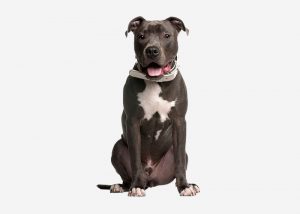
The American Pit Bull Terrier (APBT) is a medium-sized, solidly built, short haired dog whose early ancestors came from England and Ireland. It is a member of the molosser breed group. The American Staffordshire Terrier and The American Pit Bull Terrier (APBT) by breed are from the same lineage; Staffordshires was the name given by American Kennel Club (AKC), and American Pit Bull Terriers by United Kennel Club (UKC). The real difference between the two breeds is 6–8″ in height and 25–35 lb in weight; the American Staffordshire Terrier being the larger of the two.The dog was bred first to bait bulls and bears. When bear-baiting and bull-baiting were deemed inhumane, rat-baiting and dog fighting became more popular. The APBT Breed was used in both sports, and its prevalence in being put in pits with rats or other dogs led to “pit” being added to its name.The American Pit Bull is medium-sized, and has a short coat and smooth well-defined muscle structure. Its eyes are round to almond shaped, and its ears are small to medium in length and can be natural or cropped. The tail is slightly thick and tapers to a point. The coat is glossy, smooth, short, and stiff to the touch. The accepted coat color can vary widely, but, both the AKC and UKC do not recognize merle coloring.Twelve countries in Europe, as well as Australia, Canada, Ecuador, Malaysia, New Zealand, Puerto Rico, Singapore, and Venezuela have enacted some form of breed-specific legislation on pit bull-type dogs, including American Pit Bull Terriers, ranging from outright bans to restrictions and conditions on ownership. The state of New South Wales in Australia places restrictions on the breed, including mandatory sterilization. The breed is banned in the United Kingdom, the Canadian province of Ontario, and few counties and cities in the United States.
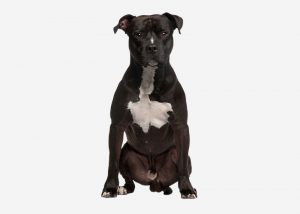
The American Staffordshire terrier also known as Amstaff is a medium-sized, short-coated American dog breed. In the early part of the twentieth century the breed gained social stature and was accepted by the American Kennel Club as the American Staffordshire Terrier in 1936. The name was changed to reflect difference from the Staffordshire Bull Terrier of England.
The American Water Spaniel, (often abbreviated to AWS), is a breed of spaniel which is one of a small number of breeds originating in the United States. Developed in the state of Wisconsin during the 19th century from a number of other breeds, including the Irish Water Spaniel and English Water Spaniels. The breed was saved by Dr. Fred J. Pfeifer, who set up the Breed club and Breed standard (dogs), and whose work led to recognition for the breed by the United Kennel Club, and later, the American Kennel Club. While they are the U.S. state dogs of Wisconsin, they remain a rare breed.They are medium sized dog, and have a double layered coat, which comes in a variety of brown related shades. A versatile hunting dog, they are also suitable for apartment life due to work by breeders to develop a breed with an even temperament. The AWS may have been involved in the development of the Boykin Spaniel.
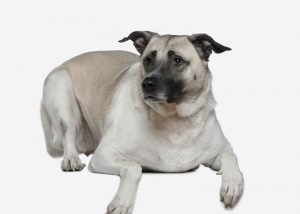
The Anatolian Shepherd Dog (Turkish: Anadolu çoban köpe?i) is a breed of dog which originated in Anatolia (central Turkey) and was further developed as a breed in America. It is rugged, large and very strong; with superior sight and hearing allowing it to protect livestock. With its high speed and agility it is able to run down a predator with great efficiency. American Kennel Club classifies as working dog, The Kennel Club classifies as shepherd dog and Fédération Cynologique Internationale classifies as molossus/mountain dog #331 (group 2 part 2.2)
The Anglo-Français de Petite Vénerie is a medium-sized breed of dog used in hunting as a scenthound, usually in packs. It is one of the Anglo-French hound breeds which were created by crossing French scenthounds with English (Anglo) foxhounds. The name Petite Vénerie does not mean that dogs of the breed are petite or small, but rather that it is used to hunt small game.
The Braque de l’Ariège, translated into English as the Ariege Pointing Dog or Ariege Pointer, is a French hunting dog of pointing gun dog type. The breed is kept primarily as a hunting dog, not as a pet or showdog.
The Ariegeois is a breed of dog from the département of Ariège in the Midi-Pyrenées region of southern France. It is a medium-sized pack-hunting scenthound deriving from crossing of Grand Bleu de Gascogne and Grand Gascon Saintongeois hounds with local Briquet dogs. It is used both as a courser and for driving game to waiting guns. While most successful with hares, it is also used for hunting deer and boar. It is distinguished by its friendly nature with other hounds and affection for human companions.
Armenian Gampr ( gamp’?) is a breed of livestock guardian dog native to the Armenian Highlands, including the territories of modern Eastern Anatolia of Turkey and the Republic of Armenia. The Armenian Gampr was bred by local people using primitive selection. Though not recognized by notable kennel clubs or fancier organizations such as a Selective breeding, pedigree dog breed, they are a distinct landrace, which has been the subject of intense genetic research.