The Treeing Cur is a purebred dog that originated in the Southern United States. It is used to tree squirrels, raccoons, and opossums, as well as to hunt big game hunting.
The Treeing Tennessee Brindle is a breed of cur. Since 1995, its records have been maintained through the American Kennel Club‘s Foundation Stock Service Program.
The Treeing Walker Coonhound is a dog breed of hound descended from the English Foxhound and American Foxhounds. They were first recognized as a separate breed in 1945. Thomas Walker had imported the English Foxhound to Virginia in 1742. The breed originated in the United States when a stolen dog of unknown origin, known as the “Tennessee Lead”, was crossed into the Walker Hound in the 19th century. The Treeing Walker Coonhound was recognized officially as a breed by the American Kennel Club in January 2012.The Treeing Walker Coonhound was bred to hunt small game, particularly raccoons and opossums. Some hunters use them for large game such as bear. They are a fast, alert, hot-nosed hunter with superb endurance, treeing ability and the desire to perform. They are vocal with a distinctive bay that allows their owners to identify their hounds from great distances. It has a clear, ringing bugle voice or a steady clear chop with changeover at the tree. These hounds are affectionate as family pets and enjoy living indoors, but they were bred for a life of action, and require a great deal of outdoor exercise.
The Trigg Hound (also known as the Trigg Foxhound or Hayden Trigg Hound) is a variety of the American Foxhound, developed in Kentucky by Colonel Haiden Trigg.
The Tweed Water Spaniel or Tweed Spaniel, is a breed of dog extinct since the 19th century. It is most well known for being involved in the early development of the modern Curly Coated Retriever and breeds of dog. They were described as a generally brown athletic dog from the area around Berwick-upon-Tweed near the River Tweed and close to the Scottish Borders. A type of water dog, the breed was not well known outside the local area. This breed may have been created by crossing local water dogs with imported St. John’s water dog, another breed of dog which is also now extinct.
The Tyrolean Hound is a breed of dog that originated in Tyrol (state).
The Vanjari Hound is a breed of dog found in India. It is a greyhound-type dog used by the nomadic Vanjari (caste) of Maharashtra, primarily as a sighthound in hunting. However, it has also been used as a guard dog and a herding dog. The breed is currently at risk from interbreeding with other dog breeds.
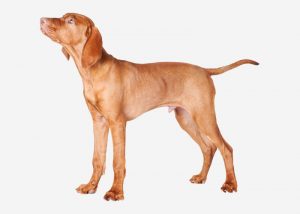
The Vizsla is a dog breed originating in Hungary, which belongs under the FCI Pointer Group. The Hungarian or Magyar Vizsla are sporting dogs and loyal companions, in addition to being the smallest of the all-round pointer-retriever breeds. The Vizsla’s medium size is one of the breed’s most appealing characteristics as a hunter of fowl and upland game, and through the centuries the Vizsla has held a rare position among sporting dogs – that of household companion and family dog.The Vizsla is a natural hunter endowed with an excellent nose and an outstanding trainability. Although they are lively, gentle mannered, demonstrably affectionate and sensitive, they are also fearless and possessed of a well-developed protective instinct.
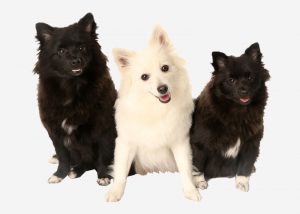
A Volpino Italiano (literally, “Italian foxy”) is a spitz type breed of dog originally from Italy.
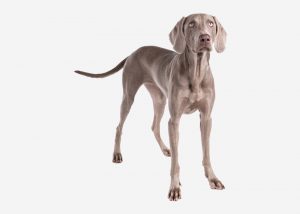
The Weimaraner is a dog that was originally bred for hunting in the early 19th century. Early Weimaraners were used by royal family for hunting large game such as boar, bear, and deer. As the popularity of large game hunting began to decline, Weimaraners were used for hunting smaller animals like fowl, rabbits, and foxes.The Weimaraner is an all purpose gun dog. The name comes from the Grand Duke of Saxe-Weimar-Eisenach, whose court, based in the city of (now in modern day Germany), enjoyed hunting.
The Welsh Sheepdog is a breed or landrace of herding dog from Wales. Like other types of working dog, Welsh Sheepdogs are normally bred for their herding abilities rather than appearance, and so they are generally somewhat variable in build, coat and size. Welsh Sheepdogs are of collie type, usually black-and-white, red-and-white or tricolour, and merle (coat colour in dogs) markings may occur over any of these combinations. The coat may be short or fairly long, and the ears are pricked, but usually folded at the tip. They are longer in leg, broader in chest and wider in muzzle than the Border Collie. They are extremely active and intelligent, and therefore need much exercise and mental stimulation, if they are to be kept as pets. Welsh Sheepdogs are more commonly known as Welsh Collies, however these are the same breed.Over many decades the Welsh Sheepdog has been widely replaced in Wales for working sheep by the Border Collie, but in more recent years efforts have been made to maintain the indigenous Welsh Sheepdog as a distinct type.Welsh Sheepdogs are usually of loose-eyed action, not fixing the stock with their gaze like the strong-eyed Border Collie. They are able to work independently without necessarily being under direct human control. Welsh Sheepdogs are most often used for herding sheep, but also readily work cattle, goats, and even horses and pigs. Traditionally they were often used as droving dogs to take cattle and sheep to markets locally or elsewhere in Great Britain.The Welsh Sheepdog’s life span is 12–15 years.
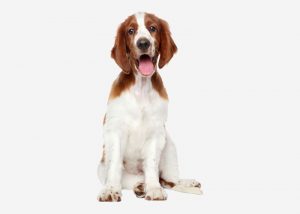
The Welsh Springer Spaniel is a breed of dog and a member of the spaniel family. Thought to be comparable to the old Land Spaniel, they are similar to the English Springer Spaniel and historically have been referred to as both the Welsh Spaniel and the Welsh Cocker Spaniel. They were relatively unknown until a succession of victories in dog trials by the breed increased its popularity. Following recognition by The Kennel Club in 1902, the breed gained the modern name of Welsh Springer Spaniel. The breed’s coat only comes in a single colour combination of white with red markings, usually in a piebald pattern. Loyal and affectionate, they can become very attached to family members and are wary of strangers. Health conditions are limited to those common among many breeds of dog, although they are affected more than average by Hip dysplasia (canine) and some eye conditions. They are a working dog, bred for hunting, and while not as rare as some varieties of spaniel, they are rarer than the more widely known English Springer Spaniel with which they are sometimes confused.