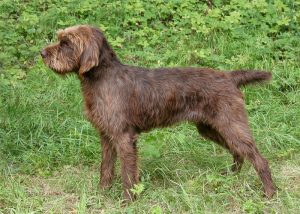
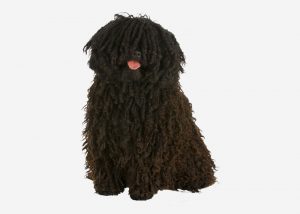
The Pont-Audemer Spaniel or Epagneul Pont-Audemer is a rare breed of French gundog. It originated in the nineteenth century from different breeds of water spaniels, and took more of a setter role in hunting than that of a traditional spaniel. Following the Second World War, the breed’s numbers dropped so low that the breed club decided to allow cross breeding with other breeds because of fears of the existing stock becoming overly inbred. In 1980, the breed club was merged with that of the Picardy Spaniel.
The poodle is a group of formal dog breeds, the Standard Poodle, Miniature Poodle and Toy Poodle (one registry organisation also recognizes a Medium Poodle variety, between Standard and Miniature), with many Coat colors. Originally bred in Germany as a Dog type of water dog, the breed was standardized in France. The poodle is skillful in many dog sports, including agility, obedience, tracking, and even herding. Poodles have taken top honors in many conformation shows, including “Best in Show” at the Westminster Kennel Club Dog Show in 1991 and 2002, and at the World Dog Show in 2007 and 2010.Toy Poodles won “Best in Show” at Crufts in 1966 and 1982. Standard Poodles achieved the award in 1955, 1985, 2002 and 2014. The 2002 winner came from Norway and was the first overseas exhibit to win the Crufts best in show award.
The Porcelaine is a breed of dog originating from France. It is believed to be the oldest of the French scent hounds. Its alternate name is the Chien de Franche-Comté, named after a French region bordering Switzerland. This caused some debate over the dog’s origin, but it has been decided that it is a French dog.

The Portuguese Podengo is an ancient multi-sensory hound (sight and scent) breed of dog from Portugal. As a breed, the Podengo is divided into three size categories that are not interbred – small (Pequeno), medium (Médio) and large (Grande). Their coats are either short and ‘smooth’ or longer and ‘wired’. The smooth coated variety is traditional, dating back to the 5th century, whereas the wire coated variety is an outcome of the assimilation of various other breeds during the 20th century. In general, the breed is healthy; the Pequeno (small) variety has an average lifespan of approximately 15–17 years. Keen hunting dogs, the Podengo has an affinity for game regardless of size. Typically, the dogs hunt in a pack (canine) with their handler following. When game is found, they kill and retrieve it or flush it towards the hunter to be shot. Each size category traditionally hunts game appropriate to their size and temperament. (Pequeno: rabbits; Médio: rabbits and wild boar; Grande: deer and wild boar).* The Portuguese Podengo in the UK is represented by, and the Podengo Pequeno was recognized by the Kennel Club in 2003. The Breed Standard was approved on January 1, 2006. The Podengo Pequeno was transferred from the Import Register into the Breed Register on January 1, 2008 at the Kennel Club. The Podengo Pequeno now has its own breed classes at Championship Shows and Open Shows (the other sizes are in the process of being included). The Podengo Pequeno was shown at Crufts for the first time in 2009. There are approximately 500 Podengos (primarily Pequeno) now resident in the UK.* All three sizes and varieties of the Portuguese Podengo have been registered at the United Kennel Club since 2004 and are in the Sighthound and Pariah Group. The Podengo Pequeno became AKC recognized in January 2013 and is now registered there. Incorporated in 2009, . is the AKC club for the breed in the US and is mostly in a few western states and the midwest. The [#cite_note-2 [2]] is the first and largest club of Podengo Pequeno owners in the USA and is in 40 states. They are the only club dedicated to BOTH the wire coat and the smooth coat varieties of the breed.The PPPCA was incorporated in January, 2003 in Newport, Rhode Island and 85% of its members own Portuguese Podengo Pequenos. Other organizations that recognize the Podengo (all sizes) in the US are the and . It is also recognized by . The Portuguese Podengo Médio and Grande are represented in the United States by .* In Europe, the Podengo is classified by the Fédération Cynologique Internationale (FCI) as Group 5: Spitz and primitive type, Section 7: Primitive type hunting dogs. The FCI breed standard, which originates in Portugal, governs all types and varieties of the Portuguese Podengo.* The United Kingdom registers the most Podengos, followed by Finland, the United States, and Portugal.* In both the United States and the UK the Portuguese Podengo is classified in the Hound Group.* All Podengo types are hardy, intelligent and lively dogs, excelling at agility and making fine companions. Loyal and fearless, Podengos are also good house guards and are amenable to training by dog experienced people and those that enjoy primitive (unrefined, “less domesticated”) dog behavior.

A Portuguese Pointer, is a breed of dog developed as a gun dog. It is one of several pointer breeds and is mainly used in Red-legged Partridge hunting.The Portuguese pointer (perdigueiro Português) arose from the ancient Iberian hunting dogs with his presence in Portugal traceable to the early Twelfth Century. Initially the dog was bred in the royal kennels and later became a very popular hunting dog for the lower classes of society. In the Eighteenth Century, many English families established a presence in the region of Oporto in the business of wine production and came to know the Portuguese hunting breed which was taken to England where they played a part in the origin of the English pointer. However, during the Nineteenth Century when Portugal was experiencing considerable social hardships, the breed began a progressive decline. It was not until the 1920s when some breeders made an effort to salvage the breed by locating some of the ancient Portuguese dogs in the inaccessible north of Portugal. The Portuguese pedigree book was then established in 1932 and breed standard in 1938.For at least a thousand years, this dog has always had the same square head, a marked stop, triangular ears and compact look.
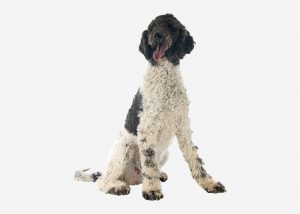
The Portuguese Water Dog is a breed of working dog as classified by the American Kennel Club. Portuguese Water Dogs are originally from the Portuguese region of the, from where the breed expanded to all around Portugal coast, where they were taught to herd fish into fishermen’s nets, to retrieve lost tackle or broken nets, and to act as couriers from ship to ship or ship to shore. Portuguese Water Dogs rode in bobbing fishing trawlers as they worked their way from the warm Atlantic waters of Portugal to the frigid fishing waters off the coast of Iceland where the fleets caught cod to bring home.Portuguese Water Dogs were often taken with sailors during the Portuguese discoveries.In Portugal, the breed is called Cão de Água literally “water dog”). In its native land, the dog is also known as the Algarvian Water Dog (Cão de Água Algarvio) or Portuguese Fishing Dog (Cão Pescador Português). Cão de Água de Pêlo Ondulado is the name given to the wavy-haired variety, and Cão de Água de Pêlo Encaracolado is the name for the curly-coated variety. However, their non-shedding qualities have made them more popular in recent years.The Portuguese Water Dog has recently gained more fame by being the chosen breed of United States president, who has two of them, and Sunny. The Obama family chose the breed partly due to its hypoallergenic status; Bo was given to the Obama family as a personal gift from Senator Ted Kennedy.
The Posavac Hound (FCI No. 154) (Croatian language: posavski goni?) is a breed of dog originating as a hunting dog of the scenthound dog type. Croatia is the home country for the breed. The name translates into English as the Scenthound From The Sava River Valley, but is usually translated as the Posavac Hound.
The Pražský krysa?ík (Prague Ratter) is a small breed of dog from the Czech Republic that is rarely seen outside its country of origin. It is the smallest breed in the world by breed standard, because of the maximum height of the dogs, unlike Chihuahuas who are measured by weight.
The Pudelpointer is a versatile hunting dog breed from Germany. It is a pointing breed that came from a cross between the German hunting poodle (pudel) and the Pointer (dog breed).

The pug is a toy dog with a wrinkly, short-muzzled face and curled tail. The breed has a fine, glossy coat that comes in a variety of colours, although most often fawn or black, and a compact square body with well-developed muscles.Pugs were brought from China to Europe in the sixteenth century and were popularized in Western Europe by the House of Orange-Nassau of the Netherlands, and the House of Stuart. modern breed preferences are for a square Cobby dog body, a compact form, a deep chest, and well-developed muscle. Their smooth and glossy coats can be fawn, apricot fawn, silver fawn or black.Pugs’ legs are very strong, straight, of moderate length, and are set well under. Their shoulders are moderately laid back. Their ankles are strong, their feet are small, their toes are well split-up, and their nails are black. Pugs are strong willed but rarely aggressive, and are suitable for families with children. The majority of the breed is very fond of children and sturdy enough to properly play with them. Depending on their owner’s mood, they can be quiet and docile but also vivacious and teasing.File:Pug 600.jpg|The breed has strong, straight legs set well under the body and a tail that curls over the hipFile:Pug portrait.jpg|Eyes should be large with a rounded shape and dark in colourFile:Sad-pug.jpg|Clearly defined, un-exaggerated wrinkles feature on the forehead
The Puli is a small-medium breed of Hungarian herding and livestock guarding dog known for its long, corded coat. The tight curls of the coat, similar to dreadlocks, make it virtually waterproof. A similar looking, but much larger Hungarian dog breed is called Komondor.
The Pumi is a medium-small terrier-type breed of sheep dog from Hungary.