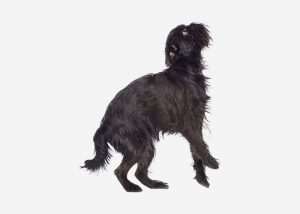
The affenpinscher is a terrier-like toy breed of dog.
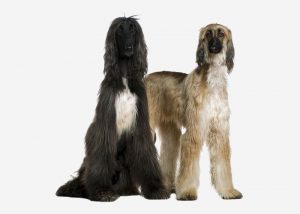
The Afghan Hound is a hound that is one of the oldest dog breeds in existence. Distinguished by its thick, fine, silky coat and its tail with a ring curl at the end, the breed acquired its unique features in the cold mountains of Afghanistan. Its local name is Tāžī Spay or Sag-e Tāzī (Dari Persian: سگ تازی). Other alternate names for this breed are Koochee dog, Tāzī, Balkh Hound, Baluchi Hound, Barutzy Hound, Shalgar Hound, Kabul Hound, Galanday Hound or sometimes incorrectly African Hound.
The Aidi or Chien de l’Atlas is a Moroccan dog breed used as a livestock guardian, protecting herds of sheep and goats. It also possesses hunting capabilities and good scenting ability. In its native Morocco it is often paired in hunting with the Sloughi, which chases down prey that the Aidi has located by scent.
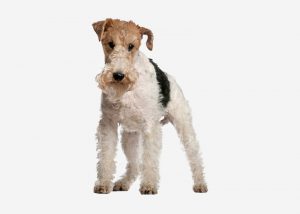
The Airedale Terrier (often shortened to “Airedale”) is a dog breed of the terrier dog type that originated in Airedale, a geographic area in Yorkshire, England. It is traditionally called the “King of Terriers” because it is the largest of the terrier breeds. Bred from a Welsh Terrier and an Otterhound, the breed has also been called the Waterside Terrier, because it was bred originally to hunt otters in and around the valleys of the River Aire which runs through Airedale. In the United Kingdom this breed has also been used as a police dog.HealthMortalityAiredale Terriers in UK, USA, and Canadian surveys had a median lifespan of about 11.5 years, which is similar to other breeds of their size.In a 2004 UK Kennel Club survey, the most common causes of death were cancer (39.5%), old age (14%), urologic (9%), and cardiac (7%). In a 2000–2001 USA/Canada Health Survey, the most common causes of death were cancer (38%), urologic (17%), old age (12%), and cardiac (6%) A very hardy breed, although some may suffer from eye problems, hip dysplasia and skin infections.MorbidityAiredales can be affected by Hip dysplasia (canine).Like most terriers, they have a propensity towards dermatitis. Skin disorders may go unnoticed in Airedales, because of their hard, dense, wiry coats. Itchy skin may be manifest as acral lick dermatitis (also known as lick granuloma; caused by licking one area excessively) or acute moist dermatitis or “Hot spot (veterinary medicine)” (an oppressively itchy, inflamed and oozing patch of skin, made worse by intense licking and chewing). Allergies, dietary imbalances, and under/over-productive thyroid glands are the main causes of skin conditions.An Airedale’s coat was originally designed to protect the dog from its predators—the coat was designed to come out in the claws of the predator the dog was designed to hunt, leaving the dog unharmed. Because of this, some forms of skin dermatitis can respond to hand stripping the coat. Clipping the coat cuts the dead hair, leaving dead roots within the hair follicles. It is these dead roots which can cause skin irritations. However, hand stripping removes these dead roots from the skin and stimulates new growth.The first Canadian registrations are recorded in the Stud book of 1888–1889.In 1910, the ATCA (Airedale Terrier Club of America) offered the Airedale Bowl as a perpetual trophy, which continues to this day. It is now mounted on a hardwood pedestal base, holding engraved plates with the names of the hundreds of dogs that have been awarded Best of Breed at the National Specialties.The Airedale was extensively used in World War I to carry messages to soldiers behind enemy lines and transport mail. They were also used by the Red Cross to find wounded soldiers on the battlefield. There are numerous tales of Airedales delivering their messages despite terrible injury. An Airedale named ‘Jack’ ran through half a mile of enemy fire, with a message attached within his collar. He arrived at headquarters with his jaw broken and one leg badly splintered, and right after he delivered the message, he dropped dead in front of its recipient.Lieutenant Colonel Edwin Hautenville Richardson was responsible for the development of messenger and guard dogs in the British Army. He, along with his wife, established the British War Dog School at Shoeburyness in Essex, England. In 1916, they provided two Airedales (Wolf & Prince) for use as message carriers. After both dogs proved themselves in battle, Airedales were given more duties, such as locating injured soldiers on the battlefield, an idea taken from the Red Cross.Before the adoption of the German Shepherd Dog as the dog of choice for police dog and search and rescue work, the Airedale terrier often filled this role.In 1906, Richardson tried to interest the British Police in using dogs to accompany officers, for protection on patrol at night. Mr. Geddes, Chief Goods Manager for Hull Docks in Yorkshire, was convinced after he went and saw the impressive work of police dogs in Belgium. Geddes convinced Superintendent Dobie of the North Eastern Railway Police, to arrange a plan for policing the docks. Airedale Terriers were selected for duty as police dogs because of their intelligence, good scenting abilities and their hard, wiry coats that were easy to maintain and clean.At the beginning of the Russo-Japanese war in 1904, the Russian embassy in London contacted Lt. Colonel Richardson for help acquiring dogs for the Russian Army, trained to take the wounded away from the battlefields. He sent terriers, mostly Airedale Terriers, for communication and sanitary services. Although these original imports perished, Airedale Terriers were reintroduced to Russia in the early 1920s for use by the Red Army. Special service dog units were created in 1923, and Airedale Terriers were used as demolition dogs, guard dogs, police tracking dogs and casualty dogs. Two Airedales were among the dogs lost with the sinking of the RMS Titanic. The Airedale “Kitty” belonged to Colonel John Jacob Astor IV, the real-estate mogul. The second Airedale belonged to William E. Carter of Bryn Mawr, Pennsylvania, Pennsylvania. Mr. Carter was the owner of the Renault automobile in which Jack and Rose trysted in the movie “Titanic”. Carter, his wife and two children survived the sinking.During the 1930s, when airedales were farmed like livestock, American breeders developed the Oorang airedale.Capt. Walter Lingo, of LaRue, Ohio, developed the Oorang Airedale strain. The name came from a line of bench champions, headed by King Oorang 11, a dog which was said to have been the finest utility dog. King could retrieve waterfowl and upland game, tree raccoons, drive cattle and sheep, and bay cougar, bears, and Gray wolf. King even fought one of the best fighting bull terriers, and killed his opponent. He also trained in Red Cross work, and served the American Expeditionary Force at the front in France.Lingo simply wasn’t satisfied with the average strain of Airedale, and after an incredible series of breedings, for which he brought in great Airedales from all over the world, he created the “King Oorang.” At the time, Field and Stream magazine called it, “the greatest utility dog in the history of the world.” The Oorang Kennel Company continued until Walter Lingo’s death in 1969. To help promote the King Oorang, as well as his kennels, Lingo created the Oorang Indians football team headed up by Jim Thorpe. The team played in National Football League from 1922–1923. Jerry Siebert, an Airedale breeder in Buckeye Lake, Ohio, followed in Lingo’s footsteps, and bred “Jerang Airedales.” There is a kennel in Tennessee that claims to have original Oorang Airedales.After the First World War, the Airedales’ popularity rapidly increased thanks to stories of their bravery on the battlefield and also because Presidents Theodore Roosevelt, Calvin Coolidge, and Warren Harding owned Airedales. President Harding’s Airedale, was the “first celebrity White House pet”.President Harding had a special chair hand carved for him to sit on at very important Cabinet meetings. In the 1920s, the Airedale became the most popular breed in the USA.President Roosevelt claimed that “An Airedale can do anything any other dog can do and then lick the other dog, if he has to.”1949 marked the peak of the Airedales’ popularity in the USA, ranked 20th out of 110 breeds recognized by the American Kennel Club.The Airedale Terrier was recognized by United Kennel Club in 1914.The Airedale Terrier was recognized by the American Kennel Club in 1888.The Airedale Terrier Club of America (ATCA), founded in 1900 is the parent club of the breed in the United States and the official-spokes organization for the breed with the American Kennel Club (AKC).The Airedale Terrier Club of America periodically holds performance and conformation events. The Airedale judged to be Best of Breed at these national specialty shows is awarded the Airedale Bowl.The Airedale Terrier Club of America
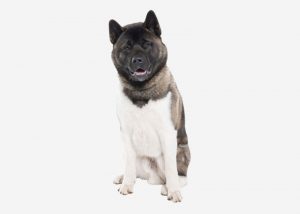
The Akita (秋田犬 Akita-inu) is a large breed of dog originating from the mountainous northern regions of Japan. There are two separate varieties of Akita: a Japanese strain, known as the “Akita Inu” or “Japanese Akita”; and an American strain, known as the “Akita” or “American Akita”. The Japanese strain comes in a small choice of colors, with all other colors considered atypical of the breed, while the American strain comes in all dog colors. The Akita has a short double coat, similar to that of many other northern spitz breeds such as the Siberian Husky, but long coated dogs can be found in many litters due to a recessive gene.
Alano Español, sometimes called the Spanish Bulldog in English, is a large breed of dog of the molosser dog type originating in Spain. The breed is best known for its former use during Spanish bullfights.
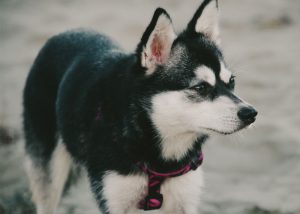
The Alaskan Klee Kai is a spitz type dog breed, developed in the 1970s to create a companion sized dog resembling the Alaskan Husky (a mixed breed of dog used for sled racing). It is an energetic, intelligent, apartment-sized dog with an appearance that reflects its northern heritage. The breed was developed with Siberian Husky and Alaskan Husky Huskies, using Schipperke and American Eskimo Dog to bring down the size without dwarfism. She bred these dogs in private until she released them to the general public in 1988. Originally called the Klee Kai, the breed split into Alaskan Klee Kai and Klee Kai for political reasons in 1995. The breed consolidated as its current name in 2002. The Alaskan Klee Kai was officially recognized by the American Rare Breed Association (ARBA) in 1995 and by the United Kennel Club (UKC) on January 1, 1997. This double coat allows them to have thermal protection from extreme hot and cold weather.Like the Siberian Husky, the Alaskan Klee Kai typically requires relatively easy care. They are extremely clean. Most do not like wet feet and will spend hours daily grooming themselves. Alaskan Klee Kai, like many other northern breeds, do not have a typical “doggy odor” or “doggy breath.” Most Klee Kai will seldom require a bath. They are rather efficient, so no grooming is needed. You never want to shave an Alaskan Klee Kai unless for medical reasons. They need their coat to keep them cool and to protect their skin. Also like Siberians (and unlike short haired dogs who Coat#Shedding all year), the Klee Kai blows its coat twice a year. Of course, the size of the dogs limits the amount of fur blown. It is best to Dog grooming the dog on a regular basis during this time. Some of the longer haired dogs can become matted if not groomed. Most Klee Kai will assist the loss of hair by rubbing against things such as fences. Other than this period of blowing coat, the Klee Kai is very self-sufficient. The normal preventative measures should be taken, such as trimming of nails, normal grooming in the form of brushing. This process is especially important in the bonding process.The Alaskan Klee Kai has a double coat; an undercoat that is short and soft and an outer coat that is made of longer guard hairs. This double coat allows them to have thermal protection from extreme hot and cold weather.HealthPreviously the Alaskan Klee Kai was thought to have been remarkably free of genetic defects when compared to other small dog breeds. Currently there is a growing concern among veterinarians that the breeding for smaller size has caused a growth in the percentage of puppies dying of hydrocephalus. Studies are on going at this time.Other health concerns that the breed may suffer from have yet to be discovered because of the breed’s relatively young age and small gene pool. Responsible Alaskan Klee Kai breeders have their dogs health tested and registered with OFA for cardiac, patellar, and thyroid issues. They are now accepted by CHIC also, if they have passed their OFA exams and eye exam by CERF.
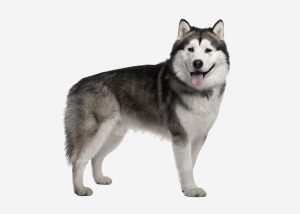
The Alaskan Malamute is a generally large breed of domestic dog (Canis lupus familiaris) originally bred for use hauling heavy freight because of their strength and endurance, and later an Alaskan sled dog. They are similar to other arctic breeds, like the Canadian Eskimo Dog, the Siberian Husky and the Samoyed.HistoryIn some accounts, the Alaskan Malamute is described as a descendant of dogs of the Mahlemut (now known as Kuuvangmiut or more commonly Kobuk) group of in upper western Alaska. These dogs had a prominent role with their human companions – as a utilitarian dog, working, hunting, and living alongside humans. The dogs were renowned for their excellent hunting abilities and were used to hunt large predators such as bears. They also aided their owners in finding seals by alerting to seal blow holes. The interdependent relationship between the Mahlemut and their dogs fostered prosperity among both and enabled them to flourish in the inhospitable land above the Arctic Circle.For a brief period during the Klondike Gold Rush of 1896, the Malamute and other sled dogs became extremely valuable to recently landed prospectors and settlers, and were frequently crossbred with imported breeds. This was often an attempt to improve the type or to make up for how few true Malamutes were available to purchase. This seems to have had no long-standing effect on the modern Malamute, and 2004 DNA analysis shows that Malamutes are one of the ancient dog breeds, genetically distinct from other dog breeds. A study in 2013 showed that the Alaskan Malamute has a similar east Asian origin to, but is not clearly related to, the Greenland Dog and the Inuit Sled Dog (Canadian Eskimo Dog), but contains a possible admixture of the Siberian Husky.(AKC) “Breed recognition came in 1935, largely through the efforts of Mrs. Eva B. Seeley. At that time many dogs were of unknown ancestry. Those who appeared purebred were used for breeding, others weeded out. After a few years the registry was closed.” “Losses from service in World War II all but eliminated the breed. In 1947 there were estimated to be only about 30 registered dogs left, so the stud book was reopened. Mr. Robert J. Zoller became involved in the breed and took this opportunity to combine M’Loot and Hinman/Irwin dogs with selected Kotzebues to create what became the Husky-Pak line. All modern Malamutes are descended from the early strains, and show combinations of characteristics in greater or lesser degree. Thus the natural differences we see today.” The Malamute dog has had a distinguished history; aiding Richard E. Byrd to the South Pole, and the miners who came to Alaska during the Klondike Gold Rush of 1896, as well as serving in World War II primarily as search and rescue dogs in Greenland, although also used as freighting and packing dogs in Europe. This dog was never destined to be a racing sled dog; it was used for heavy freighting, pulling hundreds (maybe thousands) of pounds of supplies to villages and camps in groups of at least 4 dogs for heavy loads.The Alaskan Malamute is a member of the Spitz group of dogs, traced back 2,000 to 3,000 years ago to the Mahlemuits tribe of Alaska.In 2010 the Alaskan Malamute was named the official state dog of Alaska.HealthLongevityThere is only one known health survey of Alaskan Malamutes, a 2004 UK Kennel Club survey with a small sample size of 14 dogs. The median lifespan of 10.7 years measured in that survey is typical of a breed their size, however this study had too small of a sample size to be considered reliable and much anecdotal evidence suggests they have on average one of the longest lifespans of large dogs, up to 15 years. The major cause of death was cancer (36%).MorbidityThe most commonly reported health problems of Alaskan Malamutes, in the 2004 UK Kennel Club survey (based on a sample size of 64 dogs) were musculoskeletal (Hip dysplasia (canine)), and hereditary cataracts. There are additional health issues in the breed whose origins are unknown at this time including varied seizure disorders found in young puppies as well as adults, Epilepsy, congenital heart problems, kidney problems and skin disorders.Other health issues in Malamutes include Elbow dysplasia, Polyneuropathy in dogs and cats, chondrodysplasia, heart defects, and eye problems (particularly cataract and progressive retinal atrophy). A growing problem among arctic dog breeds, including the Alaskan Malamute, but especially their cousin, the Samoyed, is canine diabetes with onset occurring typically in middle age (5 to 7 years)
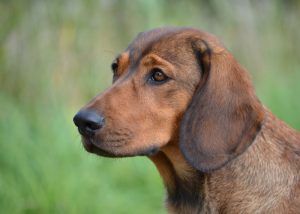
The Alpine Dachsbracke (German language Alpenländische Dachsbracke) is a small breed of dog of the scent hound type originating in Austria. The Alpine Dachsbracke was bred to track wounded deer as well as boar, hare, and fox. It is highly efficient at following a trail even after it has gone cold. The Alpine Dachsbracke is very sturdy, and Austria is said to be the country of origin.HistoryAlpine Dachsbrackes, as with the other Bracke, can be dated back to the middle of the 19th century. The Dachsbrache were bred down in size by crossing the larger dogs with Dachshunds. It once was a favorite of German royalty. During the 1880s, Alpine Dachsbrackes accompanied Crown Prince Rudolf of Habsburg on hunting trips to Egypt and Turkey.The Fédération Cynologique Internationale recognizes the Alpine Dachsbracke in Group 6 Scenthounds, Section 2 “Leash Hounds” with the Bavarian Mountain Scenthound (Bayrischer Gebirgsschweisshund, no. 217) and the Hanoverian Scenthound (Hannover’scher Schweisshund, no. 213). The only major kennel club in the English-speaking world to recognise the Alpine Dachsbracke is the United Kennel Club (US) in their Scenthound Group, but they use the Fédération Cynologique Internationale breed standard. The breed is also recognized by a number of minor registries, hunting clubs, and internet-based dog registry businesses.

The Alpine Spaniel is an extinct breed of dog which was used in SAR dog by the Augustinian canons regular, who run hospices in the region around the Great St. Bernard Pass. The spaniel was a large dog notable for its thick curly coat. One of the most famous specimens of the Alpine Spaniel is, however his preserved body has been modified on more than one occasion to fit with descriptions of the extinct breed from earlier time periods. Due to the conditions in the Alps, and a series of accidents, extinction was discussed as a possibility by authors during the 1830s, and at some point prior to 1847 the entire breed was reduced to a single example due to disease. Evidence held at the Natural History Museum in Bern show that two distinct breeds of dog were being used in the area during this time period. The breed is thought to be the predecessor to the modern St. Bernard and the Clumber Spaniel.HistoryAlpine spaniels were kept by the canons of the monasteries in the Alps in order to search for travellers during heavy snow storms, including the Great St. Bernard Hospice in the Great St Bernard Pass between Italy and Switzerland. The dogs would be dispatched in pairs to search for fallen travellers, and were trained so that upon finding them would return to the canons in order to lead rescuers back to the unfortunate individuals. The Alpine breed was also used as a Guard dog to guard sheep and cattle of mountainous regions, including the Himalayas.Between 1800 and 1814, a dog named Barry lived as a rescue dog at the hospice, and was famous enough at the time for his body to be preserved at the Natural History Museum of Bern. However during the preservation, the taxidermist and the director of the Museum agreed to modify the body towards what they thought was a good example of the breed during that period. The head itself was further modified in 1923 to represent the Saint Bernard of that era. Prior to this the skull was a great deal flatter with a moderate stop. In 1829 a English Mastiff like dog was brought from the Great St Bernard Hospice and was exhibited in London and Liverpool to thousands of people. This publicised the existence of an Alpine Mastiff, but drawings of the dog did not match descriptions of the Alpine Spaniel from before the exhibition, and the descriptions of the Spaniel were ridiculed by later publications.
The American Bulldog is a breed of working dog. The names associated with the Bully and Standard types are those of the breeders who were influential in developing them, John D. Johnson (Bully) and Alan Scott (Standard).
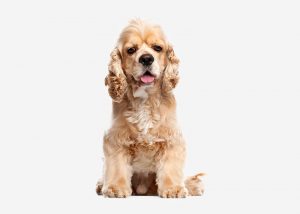
The American Cocker Spaniel is a breed of sporting dog. It is a spaniel type dog that is closely related to the English Cocker Spaniel; the two breeds diverged during the 20th century due to differing breed standards in America and the UK. In the United States, the breed is usually called the Cocker Spaniel, while elsewhere in the world, it is called the American Cocker Spaniel in order to differentiate between it and its English cousin. The word cocker is commonly held to stem from their use to hunt woodcock in England, while spaniel is thought to be derived from the type’s origins in Spain.The first spaniel in America came across with the Mayflower in 1620, but it was not until 1878 that the first Cocker Spaniel was registered with the American Kennel Club (AKC). A national breed club was set up three years later and the dog considered to be the father of the modern breed, Ch. Obo II, was born around this time. By the 1920s the English and American varieties of Cocker had become noticeably different and in 1946 the AKC recognised the English type as a separate breed. It was not until 1970 that The Kennel Club in the UK recognised the American Cocker Spaniel as being separate from the English type. The American Cocker was the most popular breed in the United States during the 1940s and 1950s and again during the 1980s, reigning for a total of 18 years. They have also won the List of Best in Show winners of the Westminster Kennel Club Dog Show title at the Westminster Kennel Club Dog Show on four occasions, and have been linked to the President of the United States on several occasions, with owners including Richard Nixon and Harry S. Truman.The breed is the smallest of the sporting dogs recognised by the AKC, and its distinctly shaped head makes it immediately recognisable. In addition, there are some marked differences between it and its English relative. It is a happy breed with average working intelligence, although by being bred to a conformation show breed standard it is no longer an ideal working dog. Members of the breed suffer from a wide variety of health ailments including problems with their hearts, eyes and ears.