Abyssinian
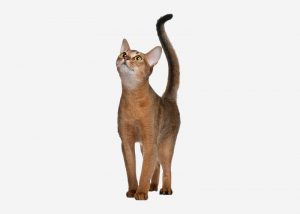
The Abyssinian /æbɨˈsɪniən/ is a breed of domestic shorthaired cat with a distinctive “ticked” tabby coat, in which individual hairs are banded with different colors.It is named after the country (now known as Ethiopia), from where it was first thought to have originated; more recent research now places its origins somewhere near the Egyptian coast. The Abyssinian has since become one of the most popular breeds of shorthair cat in the USA.HistoryThe Abyssinian cat as it is known today was developed in Great Britain. The name ‘Abyssinian’ refers to Ethiopia, in reference to widely-spread stories of British soldiers deployed to North Africa in the nineteenth century returning home with kittens purchased from local traders.However, more recent genetic research suggests the breed actually originated in Egypt and other areas near the coast of the Indian Ocean, where colonists may have purchased animals from wild animal traders. The modern breed is believed by some to have originated from one female kitten named Zula, who was taken from Alexandria by a British soldier and brought to England in 1868. However, there is no solid link between Zula and the cat first listed as an Abyssinian in 1882.HealthThe breed can be prone to gingivitis, which can lead to more serious periodontitis. Familial renal amyloidosis or AA amyloidosis, a kidney disorder due to a mutation in the AA amyloid protein gene, has been seen in Abyssinians. The Abyssinian has had severe problems with blindness caused by a hereditary retinal degeneration due to mutations in the rdAc gene. However, the prevalence has been reduced from 45% to less than 4% in 2008 in the country of Sweden. With the widespread availability of rdAc mutation detection tests and services, such as those provided by the UC Davis Veterinary Genetics Laboratory, it is possible to reduce the disease frequency in all populations of AbyssinianGenetic diversityThe 2008 study The Ascent of Cat Breeds: Genetic Evaluations of Breeds and Worldwide Random-bred Populations by Lipinski et al. conducted at UC Davis by the team led by leading feline geneticist Dr Leslie Lyons found that the Abyssinian has a low level of genetic diversity, a heterozygosity value of 0.45 within a range of 0.34-0.69 for all breeds studied, and has genetic markers common to both Southeast Asian and Western breeds indicating that cats from both Asia and Europe were used to create the breed.In popular cultureJake from The Cat from Outer Space.The possible breed of the mysterious cat Cassandra in the Cats the Musical 1998 film.In the 500th episode of The Simpsons, Abyssinian cats are described as intelligent cats who are able to “change channels” on TV.“Jackpot,” an episode of “CSI” (season 4, episode 7) features a blue Abyssinian named Isis as a significant clue.BBC Broadcaster Desmond Carrington has an Abyssinian cat called Sam, and always mentions him in his radio broadcasts
Aegean cat
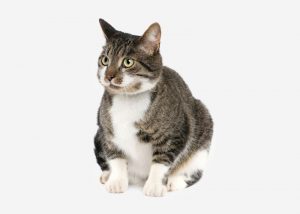
The Aegean cat is a naturally occurring landrace of domestic cat originating from the Cyclades of Greece. Development of the Aegean cat as a formal breed began in the early 1990s by breeders in the fledgling Greek cat fancy, but the variety has yet to be recognized by any major fancier and breeder organization. It is considered to be the only Indigenous (ecology) Greek variety of cat.HistoryThe Aegean cat, as its name suggests originates from the Cyclades in the Aegean Sea, where they occur as a natural landrace. Aegeans are considered one of the oldest domesticated cat breeds. They are common as feral cats in Greece, where they are found amongst fishing ports begging for food. In Greece, Aegean cats are considered a national treasure.
American Bobtail
The American Bobtail is an uncommon breed of domestic cat which was developed in the late 1960s. It is most notable for its stubby “bobbed” tail about one-third to one-half the length of a normal cat’s tail. This is the result of a cat body type genetic mutation affecting the tail development, similar to that of a Manx (cat). and the American Cat Fanciers Association (ACFA). The breed is technically now also sanctioned in the Cat Aficionado Association (CAA) of China, by virtue of the CAA having adopted all of ACFA’s breed standards; it is unknown if any specimens are actually in China. The breed is “recognized” (as existing), as both American Bobtail Longhair and American Bobtail Shorthair, in the Germany-based World Cat Federation (WCF), but is not “accepted” for competition
American Curl
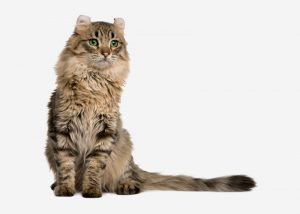
The American Curl is a breed of cat characterized by its unusual ears, which curl back from the face toward the center of the back of the skull. An American Curl’s ears should be handled carefully because rough handling may damage the cartilage in the ear. The breed originated in Lakewood, California, as the result of a spontaneous mutation. In June 1981, two stray kittens were found and taken in by the Ruga family. The kittens were both longhaired, one black and the other black and white. The family named them Shulamith and Panda respectively, but Panda disappeared several weeks later, making Shulamith the foundation female of the American Curl breed.HistoryIn 1986, an American Curl was exhibited at a cat show for the first time, and in 1992, the longhaired American Curl was given championship status by The International Cat Association (TICA). In 1999, the American Curl became the first breed admitted to the Cat Fanciers’ Association (CFA) Championship Class with both longhair and shorthair divisions.The American Curl is a medium sized cat (5–10 lbs), and does not reach maturity until 2–3 years of age. They are strong and healthy.American Curl kittens are born with straight ears, which begin to curl within eighty-two days. After four months, their ears will not curl any longer, and should be hard and stiff to the touch. A pet quality American Curl may have almost straight ears, but showcats must have ears that curl in an arc between 90 and 180 degrees. A greater angle is preferable, but cats will be disqualified if their ears touch the back of their skulls.Both longhaired and shorthaired American Curls have soft, silky coats which lie flat against their bodies. They require little grooming and enjoy spending time with their owners.The American Curl, while still an uncommon breed, is found across the world in the United States of America, Spain, France, Japan, Russia, and many other countries.HealthDue to its large genetic pool with non-pedigree cats, the American Curl is generally a healthy breed. These cats’ ears however require frequent cleaning to prevent infections, and needs gentle handling to prevent damage.Various matings between curled cats and normal cats revealed a dominant inheritance of the curl gene. Sex linked distribution was not found. The mutant gene was designated as curl and is symbolized by Cu. Another mutation of the ear pinna was found in Scottish Fold cats. In these cats anomalies were rarely found when heterozygous, however in homozygous (FdFd) cats, animals suffer from dysplasia of the lower limbs and tail. So the question arises if homozygous curls (CuCu) could also be affected by cartilage formation defects and bone abnormalities. However observations of a CuCu cat over two years showed no sign of anomaly.In popular cultureIn the webcomic Achewood, the character Ray Smuckles has admitted to being an American Curl.
American Shorthair
The American Shorthair (ASH) is a breed of domestic cat believed to be descended from European cats brought to North America by early settlers to protect valuable cargo from mice and rats, there are not a great variety of mixed breeds with American Short Hair heritage. According to the Cat Fancier’s Association, in 2012, it was the 7th most popular breed of cat in the United States.HistoryWhen settlers sailed from Europe to North America, they carried cats on board – ships’ cats – to protect the stores from mice. For instance the cats that came over on the Mayflower with the Pilgrims to hunt rats on the ship and in the colony. Many of these cats landed in the New World, interbred, and developed special characteristics to help them cope with their new life and climate. Early in the 20th century, a selective breeding program was established to develop the best qualities of these cats.The American Shorthair is a pedigreed cat breed, with a strict conformation standard, as set by cat fanciers of the breed and the North American Cat fancy associations such as The International Cat Association (TICA) The breed is accepted by all North American cat registries. Originally known as the Domestic Shorthair, the breed was renamed in 1966 to the “American Shorthair” to better represent its “all-American” origins and to differentiate it from other shorthaired breeds. The name “American Shorthair” also reinforces the fact that the breed is a pedigreed breed distinct from the random-bred non-pedigreed domestic short-haired cats in North America, which may nevertheless resemble the ASH. Both the American Shorthair breed and the random-bred cats from which the breed is derived are sometimes called “working cats” because they were used for controlling rodent populations, e.g. on ships and farms.
American Wirehair
The American Wirehair is a cat breed originating in the United States. As of 2003, though the breed is well-known, it is ranked as the most rare of the 41 Cat Fanciers’ Association breeds, with only 22 registered, down from 39 in 2002.HistoryThe American Wirehair is a spontaneous mutation of the American Shorthair. It first occurred as a random mutation among a litter of five born to a pair of barn cats in 1966 in Vernon, in upstate New York. This single red-and-white male had wiry fur. The owner of the cats called a local breeder of Rex cats, Mrs. Joan O’Shea, to take a look at the kitten. She bought the kitten for $50, along with one of his normal-coated female littermates, to start a breeding program. The wirehaired male was named Adam, and the female Tip-Top.Breeding between the two produced wirehaired kittens, many of which were sold off to other interested breeders. As the population grew, cats were exported to Canada, and Germany where they are especially popular. The breed did well, and in 1967 it was recognized by the CFA, and in 1978, it was accepted for championship competition.
Arabian Mau
The Arabian Mau is a breed of domestic cat originated from the desert cat, a short-haired landrace native to the desert of the Arabian Peninsula, which lives there in the streets and has adapted very well to the extreme climate. The Arabian Mau is recognized as a formal breed by few Cat fancy and cat registry, World Cat Federation (WCF) and Middle East Cat Society (MECATS). Based on one landrace, the Arabian Mau it is a natural breed.It is medium in size, with a body structure that is rather large and firm, not particularly slender, and with well developed musculature. The legs are comparatively long, with oval paws.The head appears round, but is slightly longer than broad. The nose is slightly concave curved, when viewed in profile. The whisker pads are clearly pronounced, with a slight pinch. The chin is very firm. The eyes are slightly oval, large and slightly slanted. The cat may have any normal cat eye colour, and there is no relation between the eye and coat colors, usually Arabian Maus have bright green eyes. The ears are large, slightly forward and sideward-placed, high-set on the skull.The tail is generally of medium length and tapers slightly towards the tip.The coat is short and lying close to the body. It has no undercoat and is firm to touch. It may not be silky, but is noticeably very glossy.
Asian
The Asian, also known as the Malayan, is a cat breed similar to the Burmese but in a range of different coat colours and patterns. Longhaired Asians of all varieties are called Tiffanies. Asians are grouped in the foreign section at cat shows.Health and careEnvironmentIt makes a good apartment cat, especially if owners will give it safe non-poisonous house plants near the windowsill, which the cat can explore. However, it is recommended that the Asian can only live in apartments, if it does not involve the city. The Asian does not enjoy loud noises from automobiles, buses or trucks. So if needed to live in an apartment, it must be one near a peaceful suburb. The Asian is not a city cat.GroomingTo keep the coat clean and shiny, owners can do that by simply taking their Asian, and stroking it, while rubbing it with using either a flannel cloth, glove or chamois. They should be brushed once a week.HealthThis is a very long-lived and healthy cat, with very few health issues.FaultsThe Asian’s faults vary: it should have blue or green eyes; they should always be solid-colored, with no white spots or streaks; the tail should never become truncated, crooked or very kinky.
Asian Semi-longhair
The Asian Semi-Longhair is a cat breed similar to the Asian except it has semi-long fur. The breed is also known by the name Tiffanie or Tiffany. They are recognized in any of the Asian Shorthair or Burmese colors and patterns. Like the Asian Shorthair, the breed was developed in Britain, and is not currently recognized by any U.S. Registries. It has full recognition in the GCCF. It is related to, and in some registries distinct from, the Chantilly-Tiffany or Foreign Longhair the North American variant.
Australian Mist
The Australian Mist (formerly known as the Spotted Mist) is a breed of cat developed in Australia.
Balinese
The Balinese is a long-haired breed of domestic cat with Siamese-style point coloration and sapphire-blue eyes. The Balinese is also known as the purebred long-haired Siamese, since it originated as a natural mutation of that breed, and hence is essentially the same cat with a medium-length silky coat and a distinctively plumed tail.
Bambino
The Bambino is a breed of cat that was created as a cross between the Sphynx and the Munchkin breeds.